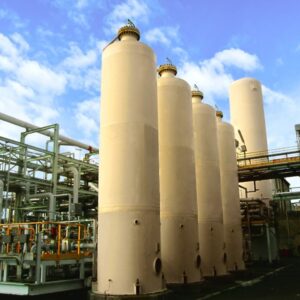
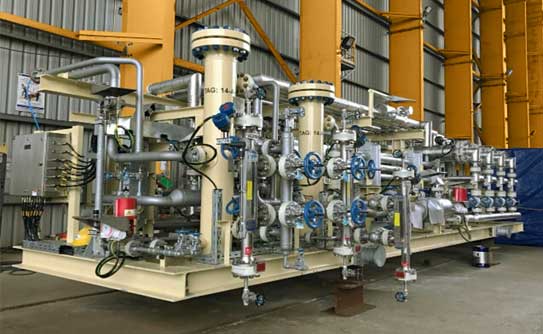
Description
How does a membrane nitrogen generator work ?
Nitrogen membrane generators work by pushing compressed air through a set of polymer fibers. As the compressed air moves through the membrane, nitrogen molecules start to become separated. This separation produces tiny microscopic holes in the membrane fibers, which allows oxygen to pass through and return into the atmosphere as a gas. Because these molecules are too large to go through these microscopic holes, they are captured at the opposite end via nitrogen generators.If your business requires lower quality nitrogen production for intermittent use, nitrogen generator membrane technology would be the ideal solution.
Membrane type nitrogen generator purity
Membrane type nitrogen generators are suited for purities up to approximately 99%, and nitrogen demand of up to around 600 Nm³/hr. It is the most robust of the nitrogen separation technologies. Compared to Pressure Swing Adsorption (PSA) technology, membranes use more energy, but have lower maintenance costs.
Oxygen and nitrogen in compressed air are separated by the relative speed of permeation through the side wall of hollow polymer fibers. Oxygen molecules permeate through the fibers faster than nitrogen molecules, enabling them to be selectively exhausted. Nitrogen gas purity increases as the flow proceeds down the fibers. Depending on the residence time in the membrane, nitrogen purity of better than 99.99% can be achieved. If you require higher purity levels, other separation technologies are more cost-effective.
Features and Benefits :
- Optimal purity range: 90% to 99.0%.
- Optimal flow rate: 1-600 Nm³/h.
- Cost advantage over vendor-supplied liquid: Up to 50%.